
Structural separation of Telecom NZ
When discussing the state of the supermarket and the electricity sector, the structural separation of Telecom is often referenced as an example to follow. An event that occurred over a decade ago.
Telecom had been the main supplier of telco services in New Zealand, and it was for many years the country’s largest listed company. But its refusal to allow competitors to provide wholesale services on its network, and a fundamental technology change from copper to fibre, brought about its undoing.
This short video explainer is informed by the first two chapters of After Structural Separation, an ebook I wrote in 2012 when I was Editor of Computerworld New Zealand.
Telecom’s origins
Telecom came into existence as a state-owned enterprise when it was carved out of the old national post office in 1987.
It was sold off in 1990 for $4.25 billion, primarily to American interests – Bell Atlantic (now part of AT&T) and Ameritech (now Verizon) and publicly listed.
The company owned all the telephone exchanges and the copper network, and it was responsible for delivering the majority of phone and data services to every home, business, school, hospital etc in New Zealand.
Local loop unbundling
In the 2000s, as access to the internet became more ubiquitous, there was a migration from dial-up to broadband. To enable broadband via copper, network devices such as DSLAMs were installed in telephone exchanges.
In addition to being a retailer, Telecom wholesaled its phone and internet services to a number of Internet Service Providers or ISPs. The ISPs wanted to put their own equipment into telephone exchanges, so that they could increase their margins and offer differentiated services.
This is known as ‘local loop unbundling’, and it would require a law-change to enact, but Telecom fought it hard. Local loop unbundling was common in almost all OECD countries, but it had been blocked from happening in New Zealand as it was claimed this would interfere with Telecom’s property rights.
As a consequence of its monopoly Telecom’s share price enjoyed a dream run in the 1990s and 2000s, and there was some concern that local loop unbundling, by challenging Telecom’s monopoly position, would adversely impact the sharemarket. In May 2004, Telecom CEO Theresa Gattung wrote to the Labour Government’s Minister of Communications Paul Swain claiming that local loop unbundling could put 20% of the sharemarket at stake.
Operational separation
Swain’s successor in the role, David Cunliffe, took a different approach and made the most of what had been an obscure ministerial portfolio. He put together a package of reforms that included not only local loop unbundling, but the operational separation of Telecom.
The 2006 reforms were approved by Cabinet and were due to be announced at the Budget in May that year, but the paper was leaked by a parliamentary courier, and the news broke in spectacular fashion, completely blindsiding the company. In her memoir Theresa Gattung described the shock she felt on hearing about the proposals, which “from our perspective were really bad.”
Operational Separation was based on the British Telecom model. It required Telecom to separate into three divisions – an access network (what became Chorus), a wholesale unit, and a retail unit.
Gattung resigned as CEO, and the former head of the BT Wholesale Paul Reynolds, was recruited to run the Operationally Separated Telecom. He relocated from Scotland for the role and led the telco for the five years that Operational Separation was in place.
Aside from ironing out all the regulatory issues, splitting into three divisions required a massive overhaul of the company’s IT systems. This was to ensure that Telecom Retail staff couldn’t see what deals had been done by Chorus, or Telecom Wholesale, with competitors.
The Telecommunications Commissioner kept a close watch, and penalties for breaking the rules were significant, as Telecom Wholesale was to discover. The division’s ‘loyalty offers’ – whereby ISPs who didn’t buy from other wholesalers – were offered discounts, were considered a breach, and Telecom was required to pay $1.2 million to its rivals.
Cabinetisation
In addition to allowing competitors to put their equipment into telephone exchanges, Telecom committed to rolling out a Fibre to the Node network, which it called ‘cabinetisation’. This was to enable more people to receive faster broadband speeds.
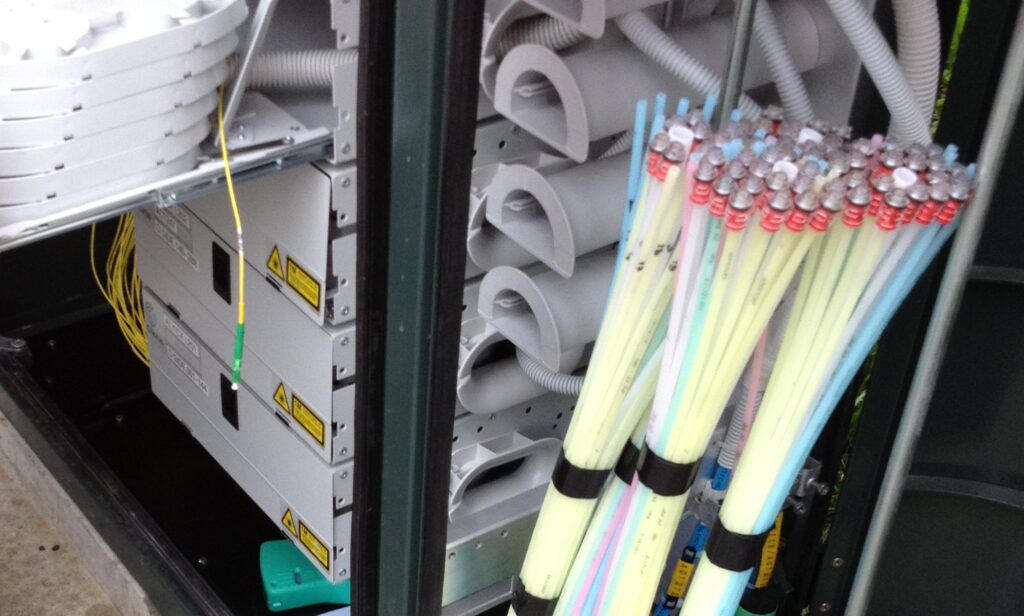
The average length of copper wires from the exchange to the home in NZ was 5kms, but to get decent speeds you needed the length to be at most 2kms. Chorus solved this problem by installing a roadside cabinet that served 300 – 350 customers, connected to the exchange by a fibre optic cable.
In less than five years Chorus installed 3,600 roadside cabinets throughout the country and upgraded 340 telephone exchanges.
At the time its competitors claimed their assets – the equipment they put into exchanges – would be stranded. But eventually unbundling did get underway, although not to the same degree as countries in which it had been the practice for many years. This was because a new technology was coming on stream, one that promised faster, more efficient speeds – fibre.
$1.5 billion pledged to a fibre network
In 2008 the Labour Government lost the general election to National, led by John Key, who prior to the election pledged $1.5 billion to build a national fibre network. He said the investment would be made according to principles which included that it be an open access network – that is any company can buy services on the basic infrastructure:
Layer zero – holes and ducts
Layer one – Fibre optic cable or ‘dark fibre’
Layer two – electronics or ‘lit fibre’
Key also promised that Government-backed network was also “not lining the pockets of the incumbents”, which meant Telecom would need to structurally separate in order to be eligible for taxpayer funding to build a fibre network.
Telecom vs the electricity companies
Under the National Government’s Minister for Communications Steven Joyce, the fibre network was branded the Ultrafast Broadband network (UFB), and the country was divided into 25 Local Fibre Companies (LFC). The idea was that half of each LFC would be funded by the government, the other half by a private investor (Telecom or a company capable of building fibre, which was primarily the electricity companies).
The LFC would dig the trenches, lay the cables and then sell ‘dark fibre’ to the telcos. The telcos would install the electronics and they in turn would sell to service providers, which would create voice and data services for businesses and consumers. Over time, as customers came onto the network, the private investor would pay down the government’s portion until it became the outright owner of that LFC.
For the next six months following this proposal it was a game of who would blink first – Telecom or the government. CEO Paul Reynolds would say publicly that they didn’t need to structurally separate, and Minister Steven Joyce would agree and point out that Telecom could invest in any LFC it wanted, it just couldn’t be a majority owner.
For the next six months following this proposal it was a game of who would blink first – Telecom or the government. CEO Paul Reynolds would say publicly that they didn’t need to structurally separate, and Minister Steven Joyce would agree and point out that Telecom could invest in any LFC it wanted, it just couldn’t be a majority owner.
The electricity companies were keen to get in on the action, and Telecom’s biggest rival was Vector in Auckland. Vector had built a fibre network using public funds under the previous Labour Government. Paul Reynolds told analysts that if Telecom didn’t get Auckland, it would walk away.
Eventually in April 2010 Telecom agreed to enter into negotiations with Crown Fibre Holdings – the entity set up to enact the Ultrafast Broadband (UFB) network.
In May 2011, it was announced that Telecom had been awarded the lion’s share of the network – about 70%. The remaining UFB contracts went to Enable Networks (a council-owned entity) in Christchurch, Northpower in Whangarei, and WEL Networks in the central North Island.
Secret negotiations scuppered
Negotiations between Crown Fibre Holdings and prospective UFB partners were conducted in secret, but a couple of fishhooks were exposed by media, and interest groups.
Notably a proposed 10-year regulatory holiday for the UFB, which would have meant the Commerce Commission had no oversight during the build phase. And a deal whereby Chorus only had to supply fibre to a maximum length of 15 metres between to house and street, whereas other partners were committed to 30 metres.
Both proposals were nixed due to public pressure, stoked by rival telcos, interest groups and technology media.
Structural Separation
Telecom structurally separated on 1 December 2011, into two companies – Chorus and Telecom (which was later rebranded to Spark).
Telecom’s assets were divided as follows:
Chorus’s assets became the core infrastructure of a fixed line telco, notably:
- the copper network
- fibre access network
- ducts and manholes
- major telephone exchange buildings
- the electronic equipment that sends voice and data signals racing down the telephone wire (DSLAMS and Ethernet aggregation switches).
Telecom (now Spark) retained the following:
- the $500 million-plus mobile network
- the Public Switched Telephone Network (PSTN, which enables a traditional fixed-line voice service)
- a national backhaul network
- ownership of Australian telco AAPT
- a majority stake in international cable Southern Cross Cable
- 30 exchange buildings and other assets, including software and IT.
Telecom shareholders received one share in Chorus for every five Telecom shares they owned.
At the final Telecom AGM in October 2011, the company estimated the split had cost it $120 million.At the final Telecom AGM in October 2011, the company estimated the split had cost it $120 million.
The two men brought in to enable Operational Separation – CEO Paul Reynolds and Chair Wayne Boyd – formerly ushered in Structural Separation and then left the company.
No one in the audience raised a concern about the split.
Wayne Boyd told the AGM that he and Reynolds had carried out 150 presentations to shareholders in New Zealand and abroad.
After the meeting Boyd told me – “you don’t come to a meeting like this unprepared.”
